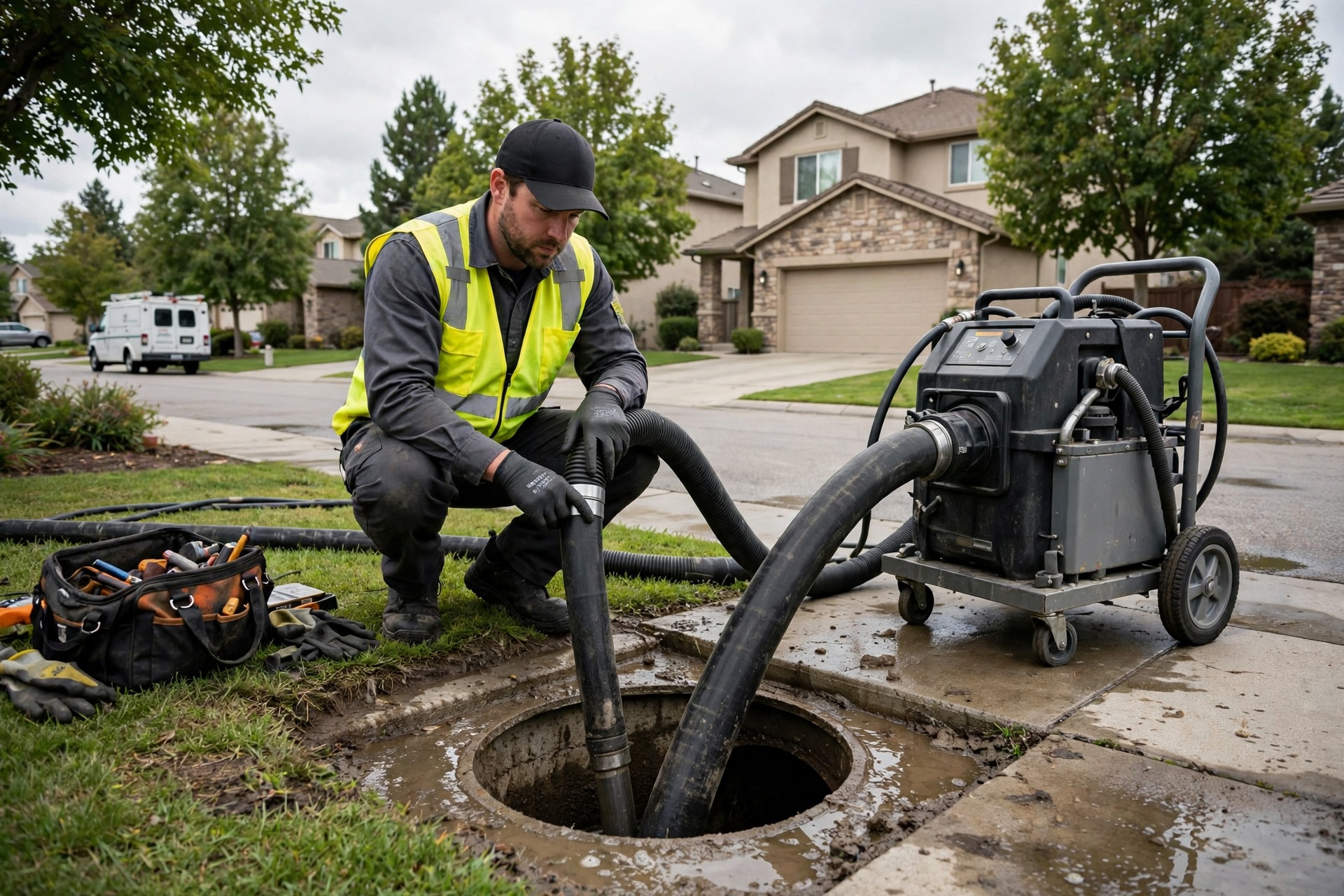
Roseville's housing stock from the 1950s through 1970s lines many blocks near the Roseville Civic Center and Veterans Memorial Park. Cast iron and clay sewer lines in these homes crack or separate over decades, allowing groundwater and sewage to back up during heavy spring rains or when snowmelt saturates the ground. Extraction crews must often pull carpet and subfloor in finished basements while containing odors that travel quickly through the connected ductwork common in these ranch and bungalow layouts.
Cold winters in Macomb County freeze shallow sewer lines running under driveways and sidewalks, especially along the Eastpointe border where older infrastructure meets newer paving. When a thaw hits followed by a warm summer downpour, hydrostatic pressure pushes waste back through floor drains. Technicians use truck-mounted vacuums rated for solids to remove standing effluent before it migrates into wall cavities or under slabs, then apply antimicrobial treatments formulated for porous concrete common in local basements.
Nearby cities such as Warren and Sterling Heights share the same glacial till soil that drains poorly, so crews frequently work jobs that cross municipal lines when backups affect multiple properties. Extraction in these conditions requires monitoring for methane pockets and coordinating with local public works to avoid discharging into storm drains that empty into the Clinton River watershed.
After extraction, crews document moisture levels in joists and drywall because Roseville's humid summers promote rapid mold growth once temperatures climb. Homeowners along Common Road often request same-day service because finished lower levels serve as primary living space rather than storage.
Technician insight
In Roseville the thing that catches most people out with sewage extraction and removal is how quickly waste migrates under the slab in 1960s homes near the Eastpointe border when the ground is already saturated from spring melt. Those shallow clay lines and the way the lots slope toward Common Road mean you often have to pull baseboard and drill weep holes before the job is truly done.
Eastpointe Border Backup After Spring Thaw
A homeowner near the Eastpointe line called after a warm spell sent meltwater into an old clay line. We found sewage had traveled under the slab into two finished rooms. Extraction and slab drying prevented mold growth before summer humidity set in.
Sewage Extraction and Removal Services We Offer
✓Basement Sewage Extraction
Removes standing sewage from finished and unfinished basements common in 1950s-1970s Roseville homes before it soaks into concrete or framing.
✓Sewer Line Backup Removal
Clears and extracts waste from main line backups affecting homes near Veterans Memorial Park and the Eastpointe border where clay pipes predominate.
✓Floor Drain Sewage Extraction
Targets localized backups through floor drains in garages and utility rooms typical of Macomb County ranch homes after heavy rain.
✓Crawl Space Sewage Removal
Extracts effluent from crawl spaces under older homes in Downtown Roseville where low clearance and poor ventilation complicate access.
✓Commercial Sewage Extraction
Handles larger-volume cleanups at small retail and office buildings along Gratiot Avenue corridors shared with Warren and Sterling Heights.
Sewage Extraction and Removal Cost in Roseville, MI
| Service | Typical Range | What Affects It |
|---|---|---|
| Standard basement extraction | $600–$1,400 | Single-room residential backup with accessible floor drain |
| Multi-room extraction | $1,200–$2,800 | Sewage spread across finished basement levels |
| Crawl space extraction | $800–$1,900 | Limited access and poor ventilation increase labor |
| Commercial extraction | $1,500–$4,000 | Larger volumes and after-hours scheduling |
Pricing confirmed on-site before work begins. Call 24/7 for immediate dispatch.
How it works
- 1
Site Assessment
Technician inspects affected areas, identifies source of backup, and maps migration paths through the home's particular layout.
- 2
Containment Setup
Barriers and negative air are placed to prevent cross-contamination into unaffected rooms and HVAC systems.
- 3
Extraction
Truck-mounted equipment removes liquid and solid waste while crews monitor for structural saturation in older floor systems.
- 4
Sanitization and Drying
Antimicrobial application followed by targeted drying of concrete, wood, and drywall to prevent mold in humid summer conditions.
- 5
Final Documentation
Moisture readings and photos provided for homeowner insurance records before equipment removal.
Pricing
Most Roseville residential extraction jobs fall between several hundred and a few thousand dollars depending on volume, access, and whether structural drying is required.